

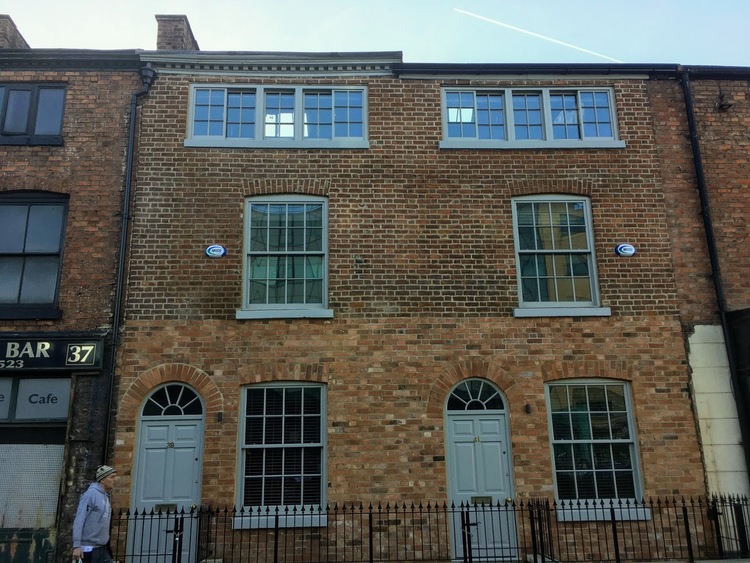
On the right hand side, look out for the Handloom Weaver's Cottages, at 41 Liverpool Rd.
Before the cotton mills opened, cloth was made by handloom weavers. The wool, or cotton, was spun by hand, and the threads were made into cloth on handlooms, this was the way cloth was produced in the middle ages.
The weavers owned their own looms, production was in the home.
You can see that this style of cottage has wide windows on the second floor, it's to let the most light into the room, where the loom was operated. The lower floors were used for hand spinning, and to live in.
It was militant handloom weavers who were at the heart of the famous mass march for democracy, in Manchester, in 1819, in what would become known as; The Peterloo Massacre.
With the introduction of steam powered spinning, and then power loom weaving, handloom weavers lost their livelihoods. They could not compete with mills that could make more cloth with much less labour.
Economic forces turned weavers into factory operatives.
The development of capitalism meant that production was no longer in the home, people went to work in the mills and factories
These new factory workers sold their 'labour power'; their capacity to work for a wage.
They had become what Engels would describe as 'proletarians', working for a wage for the Mill Owners, who were part of the bourgeoisie.
Walking route.
Turn left up Barton St opposite the cottages, then left at the top and stand by the street sign, Tonman St.