

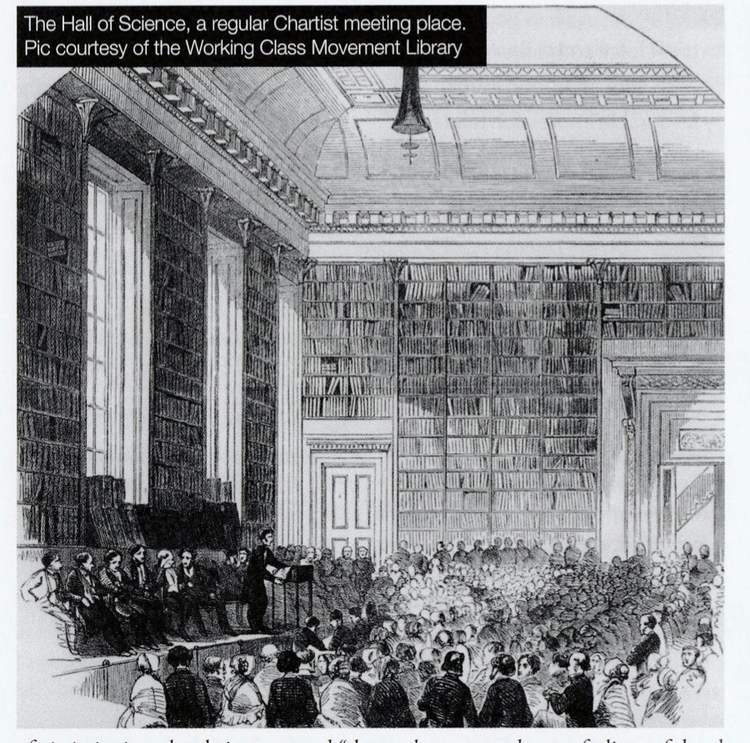
Standing by the Tonman St sign, you are in the location of what was, The Hall of Science.
The Hall of Science was opened in 1840, at a cost of £6,000, the money was raised by the followers of Robert Owen, a factory owner but also the most famous English socialist of the early 19th century.
After working long hours in the mills, many workers went to this huge hall and library. It was packed out every Sunday.
Where Engels met workers and the Chartists.
From when he first arrived in the autumn of 1842, Engels, became a regular attender. He loved the vibrancy of the workers he met in Manchester.
Radical and socialist literature were widely sold here and there were lectures given by leading socialists and Chartists, whom Engels met.
Manchester had recently been the centre of a massive General Strike. A conference of delegates - from striking factories, mills, and towns - met here in August 1842.
As workers discussed how to stop wage cuts, and how to 'make the Charter the law of the land', soldiers surrounded the building.
The political meetings and rallies, the sharing of ‘banned’ publications, reading of radical newspapers; all made Manchester, with thousands of members of the world’s first working class movement, The Chartists, a hotbed of radicalism and rebellion.
Engels described the Hall at the time in a letter to a publication called Swiss Republican.
'At first one cannot get over one’s surprise on hearing in the Hall of Science the most ordinary workers speaking with a clear understanding on political, religious and social affairs: but when one comes across the remarkable popular pamphlets and hears the lectures of the socialists … one ceases to be surprised.'
'Furthermore there are also Sunday lectures, which are very diligently attended; thus during my stay in Manchester I saw the Hall of Science which holds about 3,000 people, crowded, every Sunday.'
Engels also described what it was like inside.
'In one corner of the hall is a stall where books and pamphlets are sold and in another a booth with oranges and refreshments, where everyone can obtain what he needs or to which he can withdraw if the speech bores him.'
'From time to time tea-parties are arranged on Sunday evenings at which people of both sexes and all ages and classes, sit together and partake of the usual supper of tea and sandwiches; on working days dances and concerts are often held in the hall, where people have a jolly time; the hall also has a café.'
The 'middle classes' hated The Hall of Science. They believed it was: a ‘den of iniquity’. There was even an attempt to burn it down.
This was one of the first places where Engels met working class people.
Fredrick meets Mary Burns.
At the Hall of Science, Engels met the young, Irish, working class woman; Mary Burns.
She was described as 'a "very pretty, witty and an altogether charming girl.’
Fredrick was described as, ‘a tall, handsome young man, with a countenance of almost boyish youthfulness.’
Mary Burns and Fredrick Engels became lovers.
They would stay together until her death twenty years later.
Mary was Engels' guide around the working class areas.
‘Although born in England, Mary’s parents had been immigrants from Tipperary, in the south of Ireland.'
He later explained how “as an Irish girl, with an extended family, she was able to take him around the slums. If he had been on his own, a middle-class foreigner, it is doubtful he would have emerged alive. And certainly not clothed!”
Walking route.
Go back along Tonman St and continue to Deansgate, take a left and walk until you come to the corner with Hardman Street.