

We start our tour outside the Science and Industry Museum, on Lower Byron Street.
This museum has exhibits that show the history of inventions, and the industrial development of Manchester.
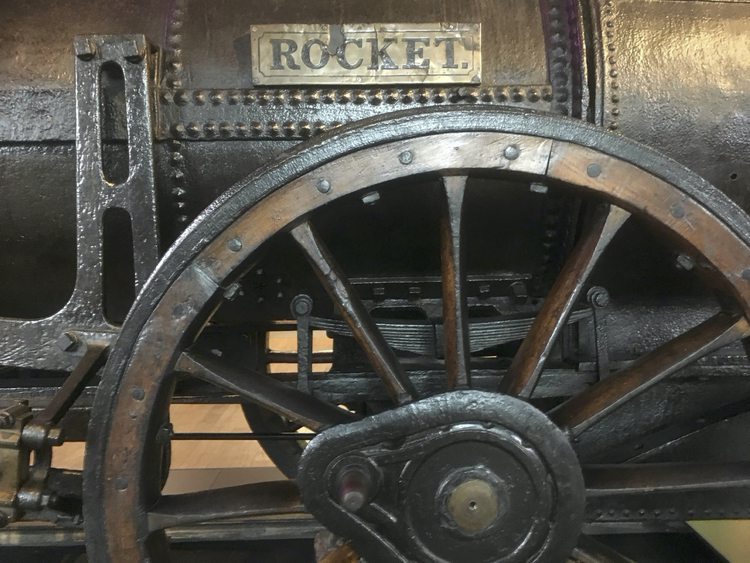
The photo is of Stephenson's Rocket, the very first passenger train, it was exhibited here in 2019.
The engine in this train became the standard template for the steam engines that powered the cotton mills.
Fredrick Engels in Manchester.
Fredrick Engels had been sent to Manchester to work as an apprentice in his father’s cotton spinning factory, the Engels and Ermen mill.
The mill was located next to Weaste station, alongside the Manchester and Liverpool railway line, and ideally situated both for cotton importers from the Mersey docks, and for drawing water from the nearby Irwell for bleaching and dyeing. The mill had a 400 strong workforce.
Engels first job was working in the 'throstle-room.’
He saw how the whole business worked at the company office on Southgate St, just off Deansgate, and the dealings at the Exchange just a short walk from the office.
Fredrick had been sent to Manchester by his father, who wanted his twenty-three year old son to keep an eye on the family business.
He also hoped to get his son away from the influence of the radical politics, that was popular amongst the youth of their home town of Brenan.
Engels really hated working at his father’s mill. It showed.
His ‘boss’ at the mill, Peter Ermen, said he only kept Engels on out of ‘loyalty to the father’, a senior partner in the firm.
Fredrick Engels, ‘worked for the firm, as little as he could get away with, and spent most of his time at political meetings, and on studying the social conditions in Manchester.’
Engels recalled: 'the most beastly of all is the fact of being, not only bourgeois, but actually a manufacturer. One who actively takes the side against the proletariat.'
'A few days in my old man's factory have sufficed to bring me face to face with the beastliness.’
’I forsook the company and dinner parties, the port wine and champagne of the middle classes, and devoted my leisure hours almost exclusively to the intercourse with plain working men and women’.
Engels political thought.
Immense productive forces are depicted in the exhibits in the Science and Industry Museum.
Engels wrote with Karl Marx, about the development of productive forces, in their most famous book, The Communist Manifesto.
'The bourgeoisie, during its rule of scarce one hundred years, has created more massive and more colossal productive forces than have all preceding generations together. Modern industry has established the world market, for which the discovery of America paved the way. This market has given an immense development to commerce, to navigation, to communication by land.This development has, in its turn, reacted on the extension of industry; and in proportion, as industry, commerce, navigation, and the railways are extended. As the bourgeoisie developed, it increased its capital, and pushed into the background every class handed down from the Middle Ages.'
From, The Communist Manifesto, Marx and Engels.
Walking route.
With your back to the Museum, walk to the right, up to Liverpool Rd, take a left and walk up to No 41.