

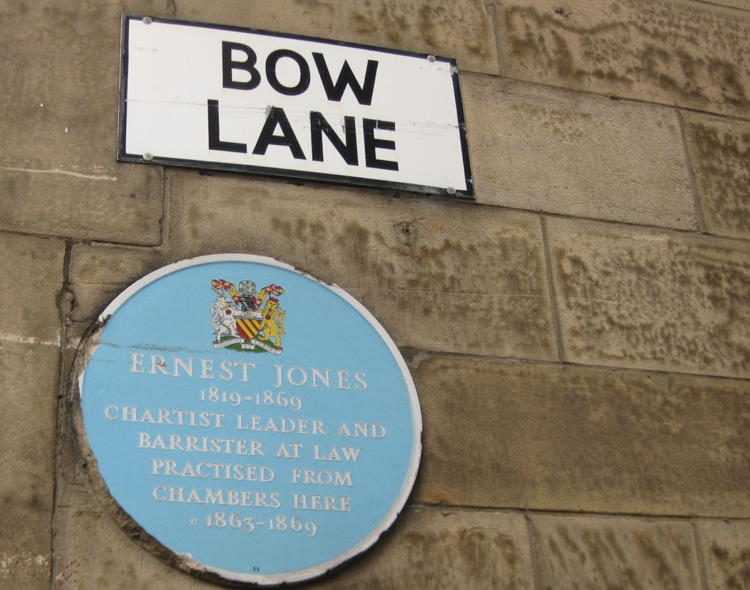
Ernest Jones office.
At the end of Bow Lane, where it meets Cross Street, is the site of the chambers where Ernest Jones practised law in the 1860s.
Jones was one of the leading Chartists, and a deputy editor of the Northern Star. He was Marx and Engels' solicitor.
Born into a wealthy family he became a Chartist in the 1840s, and was on its “physical force” wing. “His conversion to the cause of Chartism was total."
His contact with Marx and Engels in the late 1840s, combined with his experience of Chartism led him to become, alongside George Julian Harney, the most significant supporter of Marxism within the British working class movement.
Jones was also a man of outstanding courage. In 1848, inspired by the revolutions in Europe, Chartism had its last upsurge, with a massive demonstration at Kennington Common, in April of that year. The bourgeoisie feared revolution, but the demonstration fizzled out.
After this defeat the government took its revenge on the Chartist leaders. Most were arrested and jailed, including Jones. He was arrested at the Mosley Arms, in Piccadilly, charged with seditious behaviour and unlawful assembly, and jailed for two years.
Jones was held in barbaric conditions, kept in solitary confinement without books, pen or paper. His cell had no table or chair and he had to keep silent. There was no fire, and rain and snow came through a hole in the roof, soaking his clothes. After sleeping on a sack of straw; he had to get up at five o’clock, go outside to dress and wash, which he could do only by breaking the ice on the water trough. He was fed revolting food and not allowed a knife and fork. He was only allowed to hear from his wife and children once every three months.
Yet they could not break his spirit. Jones managed to write poetry by stealing materials from the prison governor’s office. His best poem, “The New Moral World”, he wrote partly in his own blood!
By the time he was released Jones had become a socialist Chartist. Heavily influenced by Marx and Engels, he argued for the ideas of the Communist Manifesto, at the meetings he spoke at.
During The Cotton Famine he wrote a pamphlet - The Slave Holder's War - that explained the reality of slavery in America. Twenty five thousand copies were printed, and sold door to door across the city.
In 1867 Jones was one of the barristers who unsuccessfully defended The Manchester Martyrs. These were three Fenians - Irish republicans - who were transferred, and then executed, for the murder of a police sergeant who had been killed when a group of Fenians escaped from custody in a police van on Hyde Road, Ardwick.
Ernest Jones died at the age of 50 in 1869. It is a sign of how popular he was that his funeral procession was a mile long and an estimated 80,000 people lined the streets as it wound its way past Strangeways, into the city, up Market Street, through Piccadilly, and finally to Ardwick Cemetery.
Let us give Engels the last word on Ernest Jones...
'Tomorrow with an enormous procession, Ernest Jones will be buried. The fellow is really a loss. Here in Manchester there is no one who can take his place with the workers. Moreover he was the only educated Englishman who was, at bottom, entirely on our side.'
Walking Notes.
Cross the road, and continue down Cross St, untill you get to the corner with, King St.