

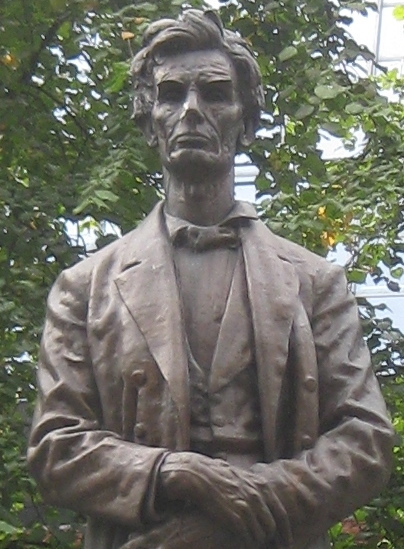
The Lincoln Statue, in Lincoln Square, Manchester England.
To recognise the support given by the working people to the 'North' in the American Civil War, there is in Manchester, a statue of President Abraham Lincoln.
Made in 1918, the statue was unveiled in 1986, in this, it's current location, by the director of a Harlem dance group.
It was originally located in what is now the Liberty Gardens, in Platt Fields, Rusholme.
A 'Lincoln stump' remains.
Engels political thought.
Writing about the American Civil War, Karl Marx and Frederck Engels explained how, the 'South', was fighting to preserve, and to extend, 'plantation slavery'.
They explained how the slave owners used racism to justify slavery, as well as to weaken resistance, and avoid rebellions.
Rallying opposition to the slaveholders, Karl Marx declared, “white skin cannot be free - if black skin is branded."
The Civil War in America meant there was no cotton, the cloth could not be sold and production stopped. The result was The Cotton Famine, which brought immense hunger and hardship to the workers.
The politicians, the press, including the Manchester Guardian, business people, the clergy, the mill owners, they all supported the 'South', the slave holding states.
In Manchester, it was three working class socialists who called a meeting to organise opposition to slavery abroad, and to link it to the fight for liberty at home.
Edward Hooson was a Chartist and an active trade unionist.
John Edwards a proponent of the cooperative movement.
Thomas Evans a former weaver had led strikes in the 1850s; he had been to America many times.
They called a public meeting. To establish a new organisation; the Union Emancipation Society.
The aim of the Union Emancipation Society, was to support Lincoln and the Union in the Civil War, and to advance the struggle for emancipation, at home, and abroad.
The Lancashire textile workers were won to an understanding of how, the emancipation of the slaves in America, was connected to their own struggles for better lives and greater freedom here at home in Britain.
The workers movement supported the North.
The biggest meeting ever held in support of President Lincoln took place in the centre of the region most affected by the Cotton Famine, at Manchester’s Free Trades Hall, on New Years Eve, 1862.
Workers voted to support Lincoln and his Emancipation Proclamation that 'freed the slaves'.
They sent a letter of support to President Lincoln. He wrote back. His letter is enscribed at the plinth.
Then from New York, two huge food ships were sent to Manchester, to feed the starving people, during the Cotton Famine.
A national rally followed in London in February 1863. Karl Marx was present, as was Frederick Engels.
From here they helped launch a world wide socialist organisation, The First International.
.... WORKERS OF THE WORLD UNITE! ...You have nothing to lose but your chains!
Walking notes.
Continue up Brazennone St, cross at the top into Albert Square.
Turn left, and cross at the lights onto Cross St. Walk on the right hand side of Cross St a short distance, and look out for the small road on the right, Bow Lane.