

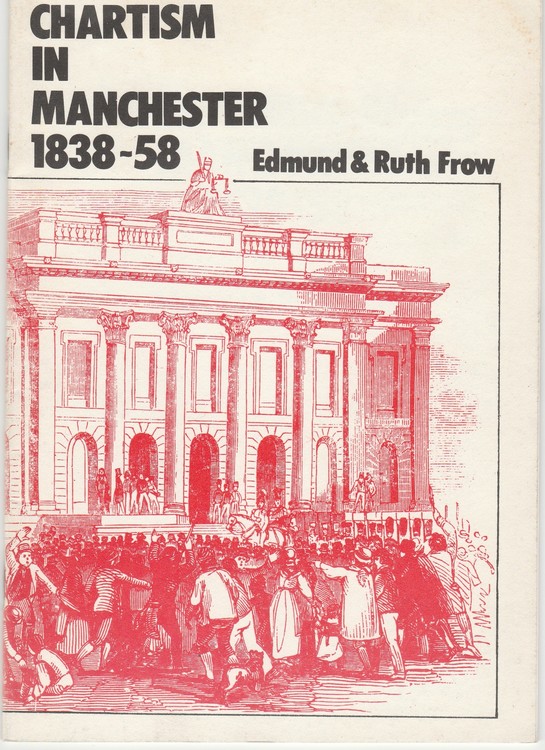
Reading the Riot Act, outside theTown Hall.
Before Albert Square was built, Manchester had a Town Hall on the corner of King St and Cross St.
The featured image shows the cover of a book on the Chartists, written by Eddie and Ruth Frow.
Chartists are depicted rallying in front of the Town Hall. Armed soldiers protect the building, the magistrates are reading, the Riot Act.
The troops had been sent by train from Ireland and Liverpool to Manchester, to quell the strike.
In August 1842 the authorities had faced a rebellion that terrified them. ‘I lost more sleep that summer’ of 1842, decried the Home Secretary.
The Chartist General Strike lasted two weeks. At its height 250,000 workers joined, from Scotland to the potteries, Manchester with its concentration of cotton mills, was the storm centre.
Ten days into the strike, local meetings elected delegates for a special Manchester Conference to be held at The Hall of Science.
Engels' Manchester was a hotbed of rebellion.
When Engels arrived in September many of the Chartists leaders were awaiting trial, or in prison.
George Julian Harney was a leading Chartist, and a journalist for the workers paper the Northern Star.
He had served time in prison for advocating strikes.
In March 1843 Harney was one of fifty-eight Chartists on trial in Lancaster for their part in the General Strike the previous year.
Despite convictions the authorities decided not to issue any sentences, so they avoided jail.
After Harney avoided prison, he became a journalist, for the Northern Star newspaper.
Two years later he would become the editor.
The Chartists had 10,000 members in Manchester alone, all red the Northern Star, the daily newspaper of the Chartists.
So many copies were being sold in Manchester that two horse drawn stage coaches were needed to transport the papers over the Pennines from Leeds where it was printed.
The Northern Star was bought by thousands, but the reports and stories were heard by many, many more as it was read out aloud at meetings, in pubs, and people’s homes.
Engels had always been an avid reader of the Northern Star.
Engels first meeting with George Julian Harney was at the office in Leeds.
Harney was impressed by Engels;
'His English, in spite of his German birth and education, was even then, remarkable for its accuracy’.
Their life long friendship began. Engels would write a string of articles in the Northern Star. He became an ‘occasional correspondent for over half a century’.
Walking Notes.
Continue walking down Cross St, turn left into St Anne's Square, and round to The Royal Exchange Theatre.