

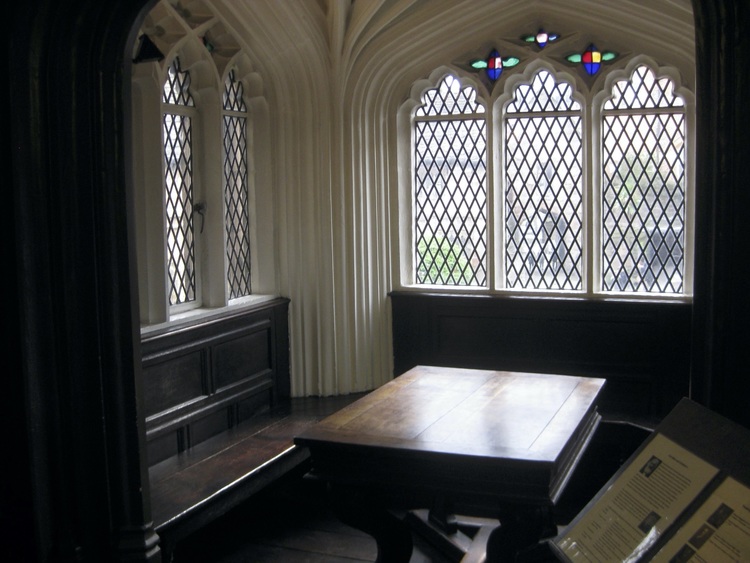
Chetham’s Library is one of the few buildings in Manchester connected with Marx and Engels that is still standing today.
The building dates from the 17th century, and is as beautiful inside as out.
When the library is open, you can visit, and - sit in this the very chair that Marx and Engels sat in!
Engels' reading room.
Engels read seven daily papers; three German, two English, one Austrian and one Italian. He was fluent in many languages, and could read about ten.
He kept up to date of the latest developments in science, technology, warfare, medicine and philosophy.
He studied government reports, medical reports, and Cholera reports, in this and other libraries in the city.
It was in this library that Marx and Engels came, in 1845, to study political economy together.
Books by Engels.
Much of the reading and research Engels did while in Manchester provided the basis for Engels' later writings, most were completed after he moved down to London.
The Housing Question, (1872); Socialism Utopian and Scientific (1880).
Explaining the material basis of women's oppression Engels wrote; "The Origin of the Family, Private Property and the State", (1884).
He wrote about the revolutionary developments in science, published in; "Anti-During", and in, "The Dialectics of Nature."
Oh, and Engles also wrote up Marx's scribblings into the Three Volumes of Capital - A Critique of Political Economy.
Only Engels could do this job, as he was the only person who could read Marx's handwriting!
Frederick Engels was in his early twenties when he wrote; "The Condition of the Working Class in England."
It was published in German in 1845.
But it was not translated into the English Language until,1887.
When it did come out, it was in - 'the book's character as a work on human ecology and the urban environment of the proletariat, reflecting the antagonism of nature and society in the new industrial towns" - that was to make Engels' work influential, and so relevant in today's world.
Engels' life.
When Engels rerturned to Manchester in 1845 with Karl Marx, Engels was able to become re-united with Mary Burns.
In the coming years they would live together, in secret, in various houses around Manchester.
Engels maintained the appearance of a 'respectable gentleman', but Mary was - "his wife in all but name".
They would later travel to Brussels together.
And then to Ireland in 1856. This was just ten years after the Great Irish Famine.
It was at this time that Engels remarked; - "Ireland may be regarded as - England's first colony."
When Mary died suddenly, in January 1863, Engels was devastated.
'Mary is dead... heart failure or a stroke. I simply can not convey how I feel!
After her funeral Engles wrote to Marx; “I felt as though with her I was burying the last vestige of my youth.”
Farewell to Manchester.
Engels wrote to Marx from this desk just before he finally departed from Manchester in 1870.
"During the last few days I have spent a good deal of time sitting at the four-sided desk in the alcove where we sat together 24 years ago. I am very fond of the place. The stained glass window ensures that the weather is always fine here."
There is little doubt that Engels was glad to leave Manchester, because of the nature of the life he had had to lead here.
He did not drive a very hard bargain with the Ermen brothers when they bought out his partnership in the firm, but he gained enough to live a comfortable life in London.
Karl Marx' daughter, Eleanor wrote:....
"I was with Engels when he reached the end of this forced labour, and I saw for myself what he must have gone through all those years.
"I shall never forget, the triumph with which he exclaimed - “For The Last Time!” - as he put his boots on in the morning, to go to the office.'
Engels legacy.
We hope you have enjoyed this walking tour of Engels' Revolutionary Manchester. ...
Let us leave the last words to Engels himself.
At the graveside of Karl Marx, Fredrick Engels could have been describing his own life, when he said of Marx:
"He was before all else a revolutionist."
"His real mission in life was to contribute, in one way or another, to the overthrow of capitalist society and of the state institutions which it had brought into being, to contribute to the liberation of the modern proletariat, which he was the first to make conscious of its own position and its needs, conscious of the conditions of - its own emancipation."
Our tour has come to an end, but you might want to visit the statue of Engels outside Home Cinema in First St M15 4GU. The statue was brought to Manchester from Ukraine where it had been toppled during the uprisings against the former Soviet Union in 1989. It is doubtful that Engels would have approved of such iconography, nevertheless it is a good place to snap a photo and have a drink in a nearby café.