

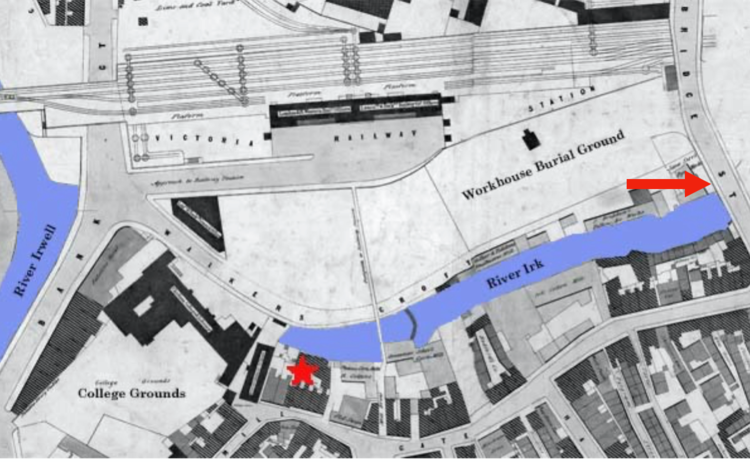
Stand by the water fountains, in Cathedral Gardens, and twenty feet beneath your feet, hidden, is the river Irk.
The featured image is an old map, the red star is where you are standing, the red arrow points to the location of; The Ducie Bridge.
In The Conditions of the Working Class in England, Engels describes life for workers living by this river.
Hell on Earth.
The spinning and weaving industry employed thousands of workers.
They ‘lived’ in overcrowded, and dirty housing, packed along the sides of Manchester’s three rivers; the Irwell, the Medlock, and, the Irk.
The first lodgings Frederick Engels took when he arrived in Manchester, was in the Strangeways district, at 70, Great Ducie Street.
A short walk from Engels’ lodgings was the area known as Angel Fields.
Engels would later described the conditions for the workers living in this area as: ‘hell on earth.’
‘This whole collection of cattle-sheds for human beings was surrounded on two sides by houses and a factory and on the third by a river, and besides the narrow stair up the bank, a narrow doorway alone led out onto another almost equally ill-built, ill-kept, labyrinth of dwellings.’
In one of his first letters home he described Manchester as a town that - changed ‘water into stinking slops.’
Engels wrote.
Right and left a multitude of covered passages lead from the main street into numerous courts, and he who turns in thither gets into a filth and disgusting grime, the equal of which is not to be found – especially in the courts which lead down to the Irk, and which contain unqualifiedly the most horrible dwellings which I have yet beheld.
In one of these courts there stands directly at the entrance, at the end of the covered passage, a privy without a door, so dirty that the inhabitants can pass into and out of the court only by passing through foul pools of stagnant urine and excrement.
This is the first court on the Irk above Ducie Bridge – in case anyone should care to look into it. Below it on the river there are several tanneries which fill the whole neighbourhood with the stench of animal putrefaction.
The first court below Ducie Bridge, known as Allen's Court, was in such a state at the time of the cholera that the sanitary police ordered it evacuated, swept, and disinfected with chloride of lime.
Standing on the Ducie Bridge looking down at the river Irk.
In dry weather, a long string of the most disgusting, blackish-green, slime pools are left standing on this bank, from the depths of which bubbles of miasmatic gas constantly arise and give forth a stench, unendurable, even on the bridge, forty or fifty feet, above the surface of the stream.
Walking notes.
Take a deep breath. Breathe...
Turn and face the windows of, Chetham Library.